The Clean Flight Claim Check
A kit for testing any cleaner-flying claim, hydrogen, battery or SAF: the energy in kilograms and liters, the tank and reserve a headline range leaves out, every CO2 figure on its scope, and any SAF offer priced per tonne it really cuts
Our Hydrogen and Battery Range Calculator compares carriers by mass and says, in its own result, that it leaves out the tank; the volume lives in a different calculator. Our SAF Blend Savings Calculator applies a lifecycle cut to the tailpipe factor, so its kilograms read 17.4% low against the lifecycle total, and the percent alone never says which scope a CO2 figure is on. The Clean Flight Claim Check carries five of our calculators through any cleaner-flying claim. In the worked example 2,000 kg of liquid hydrogen reaches 3.8 times the range of 2,000 kg of jet fuel with no tank counted, a lead that is gone once the tank weighs more than 2.84 kg per kg of hydrogen; matching jet fuel's energy takes 4.04 times the volume. A 30% blend of SAF with a 75% cut lowers lifecycle CO2e by 22.5%, and a $12 add-on covering 20% of a seat's fuel costs $757 or $6,061 a tonne depending on whether the fuel's cut is 80% or 10%. Every figure is computed by our calculators' own code; the example numbers are tagged. Sourced figures (ICAO's 3.16, CORSIA's 89 g/MJ baseline and 10% minimum, IATA's around 80% for waste HEFA, the DOE and ICCT energy figures) are quoted with their dates. It never says a blend, credit or contribution makes a flight zero carbon, and it is not a flight-planning or fuel-loading aid. Included: seven steps, four printable working pages, reference tables with dated sources, a quickstart, and a personalised sheet worked from the numbers you entered in our calculators.
Look inside
Two full pages from the kit, exactly as printed. Click either to read it at full size before you decide.
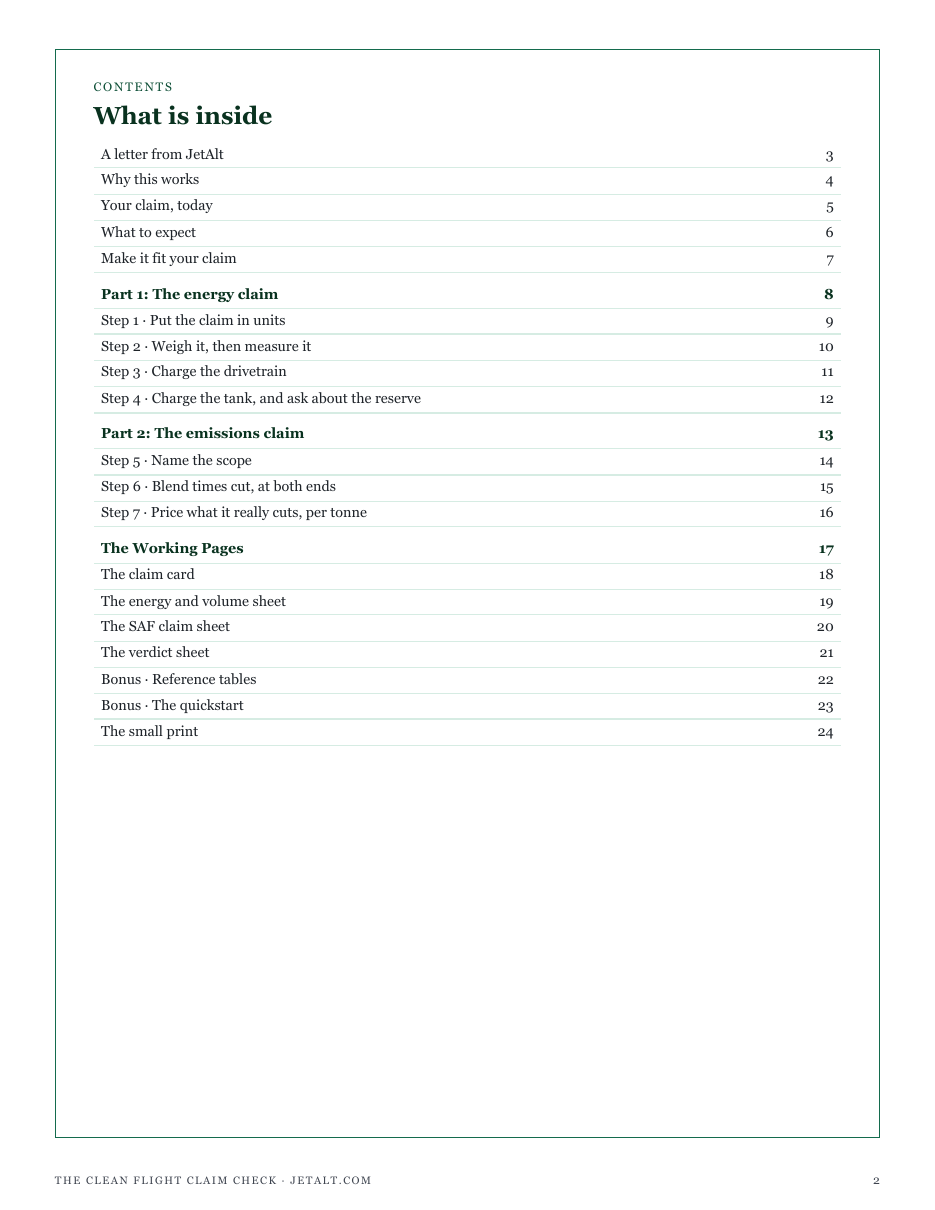
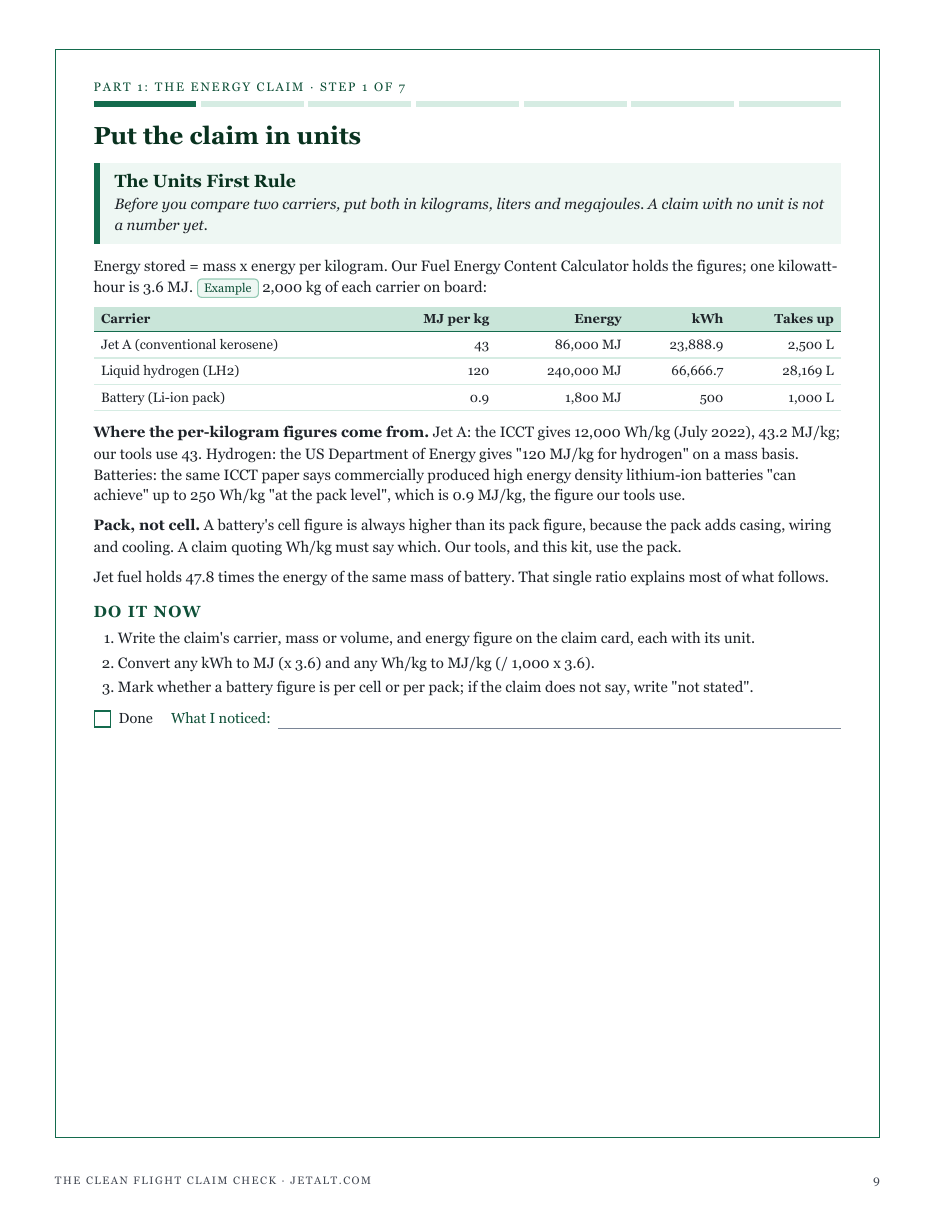
What is in it
- The Units First Rule: any claim in kilograms, liters and megajoules, with battery figures per pack
- The Mass and Volume Rule: the mass and the volume of hydrogen and batteries that match jet fuel's energy
- The Usable Energy Rule: range from the energy left after the drivetrain, rounded down
- The Whole System Rule: the tank charged to the same system mass, the break-even tank weight, and the reserve question
- The Two Scope Rule: tailpipe CO2 against lifecycle CO2e for the same fuel, and what neither counts
- The Blend Times Cut Rule: any SAF blend across the sourced range of lifecycle cuts, never zero carbon
- The Per Tonne Rule: a SAF fare or add-on priced per tonne of lifecycle CO2e it cuts, at both ends
- Four printable working pages: claim card, energy and volume sheet, SAF claim sheet, verdict sheet
- Reference tables for four carriers and a blend grid, with every source and its date
- A quickstart checklist and a personalised sheet worked from your own calculator inputs
- ✓ 24 printable pages
- ✓ 10 sections, worksheets and templates
- ✓ A second PDF worked out from the numbers you enter
- ✓ No account needed, just an email address
- ✓ Instant download; link valid 7 days
Price includes any taxes. Sold by GrabURL, who handle checkout and support. The charge appears on your statement as GrabURL.
The kit picks up where the free Hydrogen and Battery Range Calculator leaves off. That calculator compares carriers by mass and says in its own result that it leaves out the tank; the Fuel Energy Content Calculator has the volume; the Jet Fuel CO2 Calculator counts tailpipe CO2 while the SAF Blend Savings Calculator quotes a lifecycle cut. The kit carries them through: one set of units, mass and volume side by side, usable energy, the tank and the reserve, the scope of every CO2 figure, blend times cut across the sourced range, and a per-tonne price. Every figure in it is an example for you to replace. No blend, credit or contribution makes a flight zero carbon.